
PSLE Science Questions
Many students lose marks in open-ended questions simply because the answers require specific keywords and structured thinking across multiple topics.
Answering open-ended questions doesn’t have to feel overwhelming.
At Glow Science, we specialise in teaching students the strategies they need to excel, not just memorise. With the right guidance, your child can approach every PSLE Science question with confidence and clarity.


Did You Know?
Some PSLE Science questions combine concepts from P3, P4, and P5 in a single question!
With our G.L.O.W. Signature Technique and targeted Concept Mixer Topics, we help your child recognise these patterns and apply the right techniques.
We guide students step-by-step on how to:
- Identify keywords
- Link evidence to concepts
- Write structured, high-scoring answers
Whether your primary school student is aiming for improvement or already doing well, our methods help students gain that extra edge.
PSLE Science Question Bank and Analysis
Heat & Its Effects
Glow Science trend analysis across the years
Introduction
- PSLE Heat questions appear almost every year
- Tested through real-life contexts, not definitions
- Often combined with Materials / Energy / Data interpretation
Glow Science trend analysis across the years
Introduction
- PSLE Heat questions appear almost every year
- Tested through real-life contexts, not definitions
- Often combined with Materials / Energy / Data interpretation
Year 2023, qn 40
Glow Science trend analysis across the years
| 40. (a) State what boiling means. [1m]Boiling is the process where a liquid gains heat and changes into a gas at its boiling point. |
To score, you must state:
- Process
- Boiling point
- Gains heat
- Liquid → gas
In recent years, definition questions have become increasingly common in both Prelim papers and PSLE.
| An engineer wanted to test if an electric pot can be used on a table with a thick glass top. He heated water in the pot for one hour.
Part A was nearer to the electric pot, so it gained heat faster than part B. |
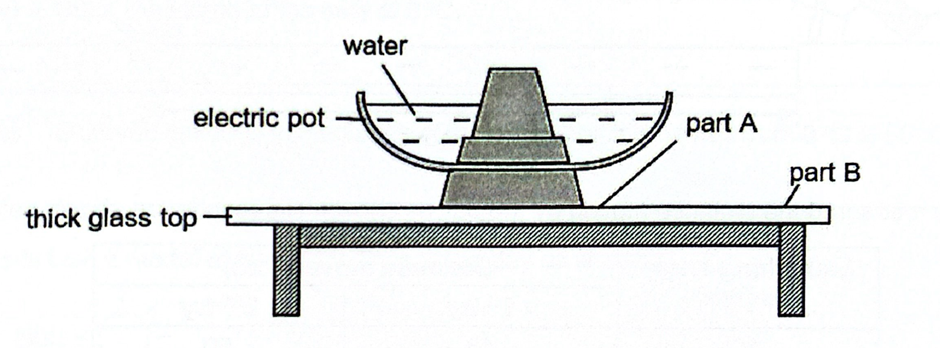 (b) (i) Explain why part A of the glass top was hotter than part B. [1m]
Concept Breakdown (GLOW Style)
-
Heat flows from hot objects to cooler objects
-
Part A is closer to the heat source
-
Thick glass slows down heat transfer to other areas
PSLE Tip:
 You do NOT need to mention “conduction” unless asked. Focus on distance + heat gain.
| (b) (ii) The glass top cracked after some time. Explain why. [1m]
Part A gained heat and expanded faster than part B. The uneven expansion caused stress in the glass, causing it to crack. |
Key Concepts
-
Matter expands when it gains heat
-
Uneven heating → uneven expansion
-
Stress builds up → cracking
Year 2024, qn 36
Year 2024, qn 36
Year 2024, qn 36
Year 2024, qn 36
Year 2024, qn 36
| 36. The graph shows how a length of wire made of material S changes with temperature.
50mm |
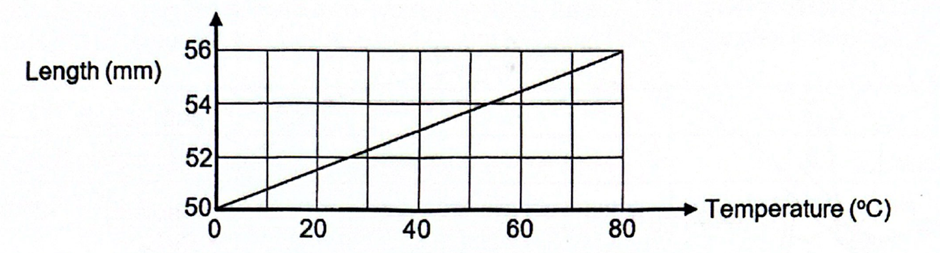 (a) State the length of the wire at 0°C. [1m]
How to read this (Glow Science explains)
- Look at 0°C on the x-axis
- Trace vertically to the line
- Read the corresponding value on the y-axis
This tests graph reading, not heat theory.
| (b) State the increase in the length of the wire when it is heated from 0°C to 80°C. [1m] 6mm |
PSLE logic breakdown (Glow Science explains)
- Length at 0°C = 50 mm
- Length at 80°C = 56 mm
- Increase = 56 − 50 = 6 mm
What concept is PSLE actually testing here?
Although this looks like a math or graph question, the core concept is HEAT: Materials expand when they gain heat.
The graph simply shows:
- As temperature increases
- The wire gains heat
- Its length increases
This concept is called expansion due to heating, and PSLE loves to test it using graphs.
Let’s take a look at part C and explore the concepts of expansion and contraction with telephone wires.
| Fadil built a model of telephones lines in the day as shown.
(c) Explain why the wires snapped at night. [2m] The wires were pulled tightly during the day. (d) Using the same type of wires and equipment, suggest how Fadil can build the model at the same place so that the wires will not snap. [1m] Leave the wires slightly loose when securing them to the supports. |
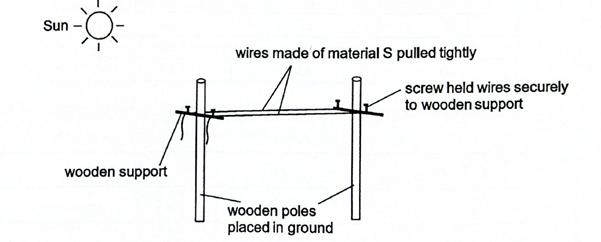 During the night, Fadil heard a crack and found that wires snapped. There was no wind and the model was not disturbed by any person or animal.
This PSLE question reinforces a recurring Heat concept — materials contract when they lose heat.
Students who understand expansion and contraction can answer confidently even when the context changes, whether it's telephone wires, bridges, or rails.
Year 2025, qn 36
| 36. Aisha squeezed a plastic bottle to put some sauce on her food.
Flexible |
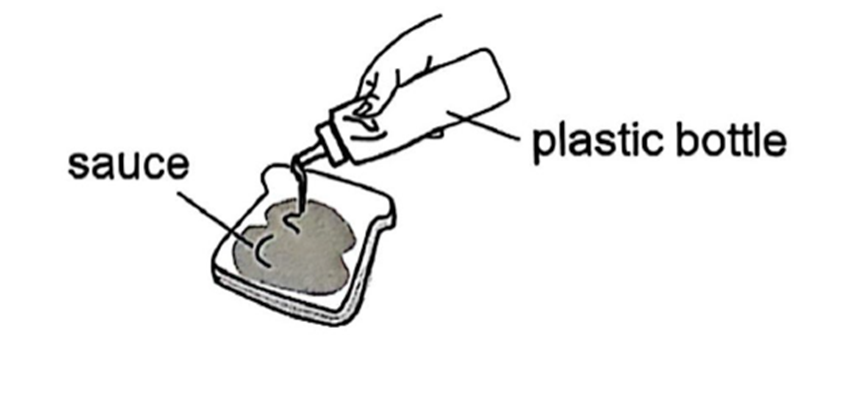 (a) State the property of the plastic to explain why Aisha can squeeze the bottle. [1m]
Exam-ready explanation:
Plastic is flexible, so it can bend and change shape when a force is applied without breaking. This allows Aisha to squeeze the bottle to push the sauce out.
Key word to score: Flexible
| Aisha took a jar out from a refrigerator. She could not remove the plastic lid at first.
After leaving the jar at room temperature, both the plastic lid and the glass jar gained heat from the surroundings. |
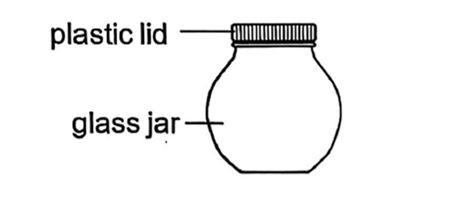 (b) Explain why she was able to remove the lid easily after leaving the jar at room temperature for some time. [2m]
Why this answer works (Glow Science breakdown)
Concept tested:
- Heat causes materials to expand
- Different materials expand by different amounts
Keywords markers look for:
- Gained heat
- Expanded
- Plastic expands more than glass
As you can see, Heat-related concepts have appeared for three consecutive PSLE years. This clearly shows that Heat is not a one-off topic, but a core concept that examiners revisit repeatedly.
Although Heat is introduced as a Primary 4 topic, it does not stay in P4.
In PSLE and school prelim papers, Heat is often tested again in higher levels, combined with other themes such as forces, materials, expansion, and energy transfer.
This makes it a high-frequency, high-importance topic.
As such, students must understand the concept deeply, not just memorise definitions.
Knowing how heat is gained, lost, and transferred, and its effects on materials, helps students confidently tackle a wide range of application and explanation questions.
If Heat is not mastered early, it becomes a weak link that surfaces again and again in exams.
But when students truly understand it, Heat becomes one of the easiest scoring topics in both prelims and the PSLE.
Forms of Energy + Forces
One of the biggest shifts in recent PSLE Science papers is the rise of “hot mix” questions — questions that combine two or more topics in a single scenario.
A classic example is the combination of Forms of Energy and Forces, where students are tested not just on definitions but also on energy conversion, force interactions, and data interpretation — all in one question.
Together, we break down a PSLE-style turtle toy question using the Glow Science G.L.O.W Technique, so students and parents can see how full-mark answers are constructed.
Why this question is tricky (PSLE examiner insight)
This question is challenging because it requires students to know the deeper concepts and the 4 steps to score well:
- Track multiple concepts, energy conversions, and forces
- Identify a force exerted by a spring
- Interpret a sound graph over time
- Link movement speed to frequency of impacts
Many students lose marks not because they “don’t know the concept from the topic and the keywords related to the specific topic for their Science”, but because they don’t link concepts across topics clearly.
Understanding the scenario (question overview)
The following is a question that appeared in the 2025 PSLE paper.

Glow Science has animated the picture to help in students’ illustration
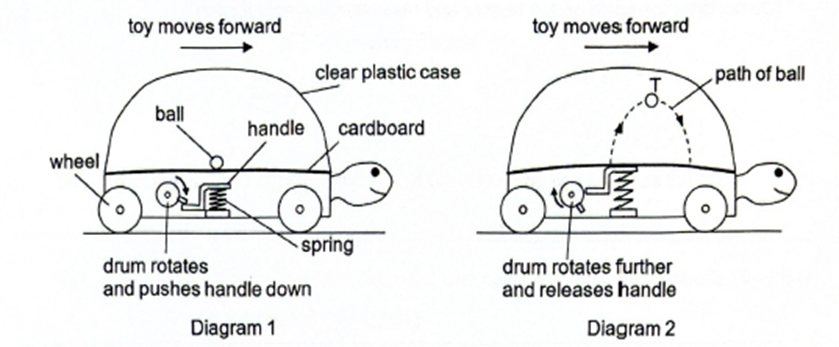
A toy turtle moves forward as its wheels rotate. Inside the toy:
- A drum rotates with the wheels
- The drum pushes a handle down, compressing a spring
- When released, the handle hits the cardboard
- A ball bounces, and sound is produced
- A sensor records sound peaks over time
This setup tests energy → force → motion → sound, all in one system.
Now, let’s answer the question together...
Year 2025, qn 38
| 38. Peiling has a toy. As the toy moves forward, a drum rotates with the wheels and pushes the handle and spring down in Diagram 1.
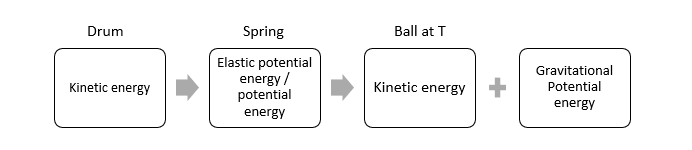
As the drum rotates further, it releases the handle to hit the cardboard and the ball bounces up as shown in Diagram 2. (a) Fill in the boxes to show the energy conversion in the toy when it is moving as shown in Diagram 1 and 2. [2m]
|
Glow Science explanation
Let us guide you through each step.
Step 1: When the Toy Moves Forward (Drum rotates with the wheels)
As the toy moves forward, its wheels turn. This causes the drum inside the toy to rotate.
Any object that is moving has kinetic energy. Since the drum is rotating, it possesses kinetic energy.
Definition (PSLE-friendly): Kinetic energy is the energy possessed by a moving object.
Since the drum is rotating, it possesses kinetic energy.
Step 2: When the Spring Is Compressed (Handle is pushed down)
As the drum rotates, it pushes the handle downwards and compresses the spring.
When a spring is compressed or stretched, energy is stored in it. The spring now has elastic potential energy.
Definition: Elastic potential energy is the energy stored in an object when it is stretched or compressed.
The spring now has elastic potential energy.
Step 3: When the Handle Is Released (Ball starts moving upwards)
When the drum rotates further, it releases the handle. The compressed spring pushes the handle up, hitting the cardboard and causing the ball to bounce upwards.
The moment the ball starts moving, it possesses kinetic energy again.
Stored elastic potential energy in the spring is converted back into kinetic energy of the ball.
Step 4: When the Ball Reaches the Highest Point (Point T)
As the ball rises, it slows down.
At the highest point (T):
- Energy is now stored due to height
Definition: Gravitational potential energy is the energy an object has because of its position or height above the ground.
At point T, the ball has gravitational potential energy.
Try testing on your own!
Glow Science exam tip 
When answering PSLE energy questions, always ask:
- Is the object moving? → Kinetic energy
- Is energy being stored in a spring? → Elastic potential energy
- Is the object at its highest point? → Gravitational potential energy
In PSLE, writing potential energy is acceptable.
Writing the full name (elastic / gravitational) shows deeper understanding. However, it is not compulsory unless the question specifically asks for it!
Next up is a very good follow-up question because it tests Forces + Energy together — exactly the kind of hot-mix PSLE question mentioned earlier.
| (b) Name the force exerted by the spring on the handle. [1m]
Elastic spring force |
Glow Science explanation
What is happening in the toy?
- As the toy moves forward, the drum rotates
- The rotating drum pushes the handle down
- This compresses the spring
- A compressed spring pushes back on the handle
That push back is the force being asked about.
Key PSLE concept
A spring that is:
- compressed or
- stretched
will exert a force that:
- tries to return it to its original shape.
This force is called elastic spring force.
Elastic spring force is the force exerted by a spring when it is stretched or compressed.
| When the handle hits the cardboard, a sound is produced and recorded by a sensor. The results are as shown.
3 times. |
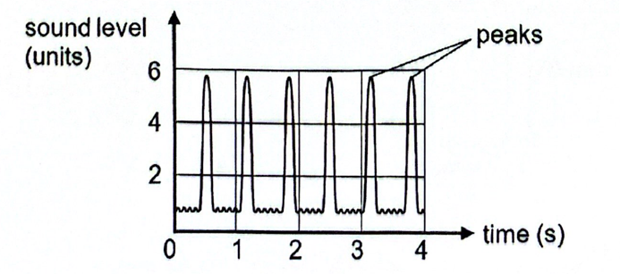 (c) State the number of times the handle hits the cardboard in the first two seconds.
Glow Science explanation
How Do We Know? (PSLE Skill)
The key idea here is very simple: Each peak on the graph represents ONE hit of the handle on the cardboard.
Why?
- When the handle hits the cardboard, a sound is produced
- The sensor records this sound as a sudden spike (peak) in sound level
So:
- 1 peak = 1 hit
Step-by-Step Explanation (Exam Technique)
- Look only at the first 2 seconds on the time axis (0 s to 2 s)
- Count the number of peaks within this time range
- You will see 3 clear peaks
 Therefore, the handle hits the cardboard 3 times in the first two seconds.
Think of the graph like this:
Every time the handle hits the cardboard, it makes a “tap” sound.
Each “tap” shows up as a tall spike on the graph.
So we simply count how many “taps” happen in the first two seconds.
There are 3 taps, so the answer is 3 times.
Glow Science tip 
Only count tall, sharp peaks AND only within the time stated in the question.
In PSLE Science, students are often required to interpret graphs. In this question, each peak in the sound-level graph represents one impact of the handle on the cardboard.
By counting the number of peaks within the first two seconds, we can determine how many times the handle hits the cardboard.
This helps students practise careful observation and accurate data interpretation — key skills tested in PSLE Science
| (d) Suggest how the graph will change if the toy moves faster. [1m]
There will be more peaks within the same time period. / The peaks will be closer together. |
Think of tapping on a table:
- Tap slowly → sounds are far apart
- Tap faster → sounds come closer together
The graph works the same way:
- Faster movement = hits happen sooner = peaks are closer together.
If the toy moves faster, the handle will hit the cardboard more frequently.
Since each hit produces a sound peak, the sound-level graph will show peaks that are closer together, or more peaks within the same time interval.
This question tests students’ ability to link motion, cause-and-effect, and graphical interpretation — a common skill assessed in PSLE Science.
Why this topic keeps appearing in PSLE Science
One of the most consistent patterns in PSLE Science papers and prelim exams across schools is the testing of Water Cycle concepts through real-life situations.
Instead of asking students to simply define evaporation or condensation, PSLE increasingly:
- Embeds the concepts in daily experiences
- Requires students to explain state changes
- Tests cause-and-effect thinking, not memorisation
Let’s look at three PSLE questions across different years to see this powerful trend clearly.
Common theme across 2020, 2021 & 2025 PSLE questions
Although the situations look different, all three questions test the same science concepts from the topic on water cycles and its 3 states (which are from the primary 5 topics) but tested in PSLE exam:
| Year | Scenario | Core Concept |
|---|---|---|
| 2020 Q12 | Frozen sausages forming white solid | Condensation & freezing |
| 2021 Q13 | Fogged spectacles | Condensation |
| 2025 Q39 | White fumes from damp shirt | Evaporation & condensation |
This is a classic PSLE “same concept, different context” strategy.
Why parents should care about this trend
These questions show that PSLE Science is now about:
- Understanding concepts deeply
- Applying knowledge to daily life
- Explaining clearly and logically
Students who only memorise definitions often struggle.
Students trained to recognise patterns and explain their thinking score consistently.
Final takeaway
If your child understands:
- How water changes states
- How temperature affects matter
- How to explain cause and effect
They are already well-prepared for a large portion of PSLE Science.
And this is exactly what Glow Science focuses on — concept mastery, not rote learning
Water Cycle & States of Matter
Year 2020, qn 40
| 40. John placed a pack of brown sausages wrapped in clear plastic from the freezer onto a table, After a short time, a thin layer of white solid was formed on the surface of the plastic wrapping.
When the cold pack of sausages was taken out of the freezer, water vapour in the surrounding air came into contact with the cold plastic wrapping and condensed into water droplets. |
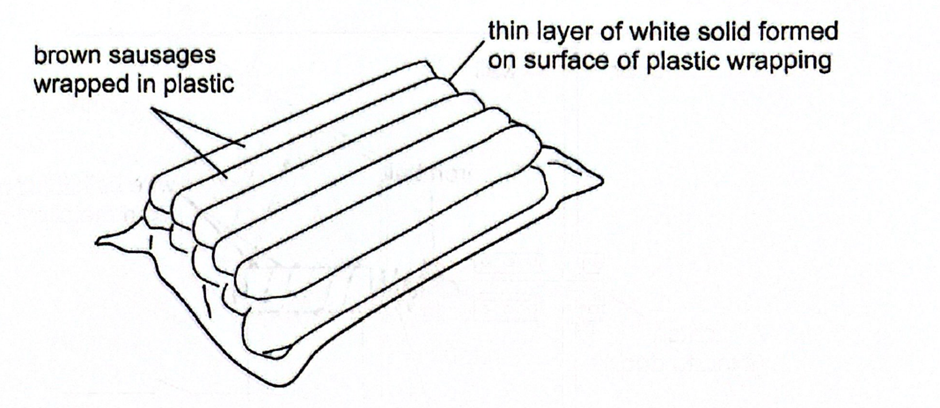 (a) Explain how the white solid was formed. [2m]
Keyword checklist (PSLE marker’s POV)
This answer clearly includes:
water vapour
cold surface
condense
water droplets
lose heat
freeze
ice / white solid
That’s exactly what markers look for.
Glow Science explanation
Think of what happens when you take a cold drink out of the fridge:
- Water appears on the outside of the bottle
- That water comes from the air, not from inside the bottle
In this case:
- The sausages were very cold
- Water vapour in the air touched the cold plastic
- It first turned into water
- Then froze into ice, forming a thin white solid
Common PSLE mistakes
 “The sausages released water”
“The plastic produced ice”
Mentioning only condensation OR only freezing
Glow Science tip
Always ask:
- What state did it start as?
- What state did it end as?
G.L.O.W Science Technique (How we teach this)
G – Give
Water vapour condensed and froze.
L – Link
The plastic wrapping was very cold.
O – Outline
Condensation occurred first, followed by freezing.
W – Wrap
Thus, a white solid (ice) was formed.
| (b) The white solid cannot be seen after a while. Explain why. [1m]
The white solid (ice) gains heat from the surroundings and melts into water, so it can no longer be seen. |
Glow Science explanation
Think of ice cubes left on a table:
- At first, you see ice
- After a while, the ice melts
- You don’t see ice anymore — only water
- Same idea here.
Glow Science exam tip
“For 1-mark ‘why’ questions, write one clear reason, not a long story.”
This 1-mark PSLE question tests students’ understanding that ice melts when it gains heat from the surroundings. Once the ice melts into water, it is no longer visible as a white solid.
Qn 40 summary
| Question Type | Marks | What to Write |
|---|---|---|
| Formation | 2 marks | Condensation + freezing |
| Disappearance | 1 mark | Melting only |
Year 2021, qn 35
| 35. Fook Choy wore a face mask in an air-conditioned room. His spectacles became fogged when he breathed.
As Fook Choy breathed out, his breath contained warm water vapour which escaped through the mask. |
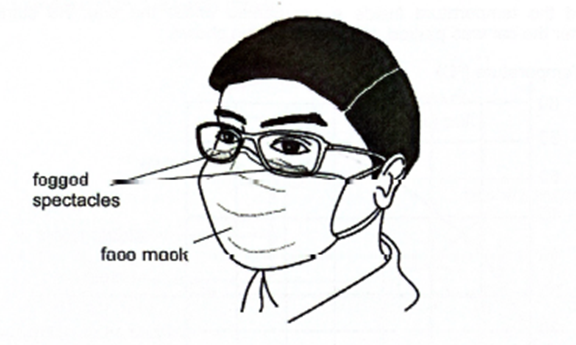 Explain why his spectacles became fogged [2m]
Glow Science explanation
Think about breathing on a cold mirror:
- Your breath has water vapour
- The mirror is cool
- Water vapour turns into tiny water droplets
- The mirror looks foggy
Same idea here — just with spectacles.
Common PSLE mistakes
“The spectacles trapped air”
“The mask caused fogging”
Not mentioning water vapour
Saying “steam” (incorrect term at primary level)
Glow Science tip
Always mention water vapour and condensation.
This PSLE question reinforces a recurring exam trend, testing condensation through everyday situations such as breathing, cold surfaces, and temperature differences.
Students who understand the water cycle concept deeply can answer confidently even when the context changes!
Year 2025, qn 39
| 39. Hassan used an electrical appliance to press a shirt that was still damp and saw white fumes rising above the shirt.
Water in the damp shirt gained heat from the hot electrical appliance and evaporated into water vapour. (b) Explain why the white fumes could no longer be seen after a short time. (P5 water cycles concept) [1m] The water droplets gained heat from the surroundings and evaporated into water vapour, so the white fumes disappeared. (c) State a suitable material for the plate of the appliance. Explain your answer. (P3 Material concept) [1m] Metal is a suitable material because it is a good conductor of heat, allowing heat to be transferred quickly to the shirt. |
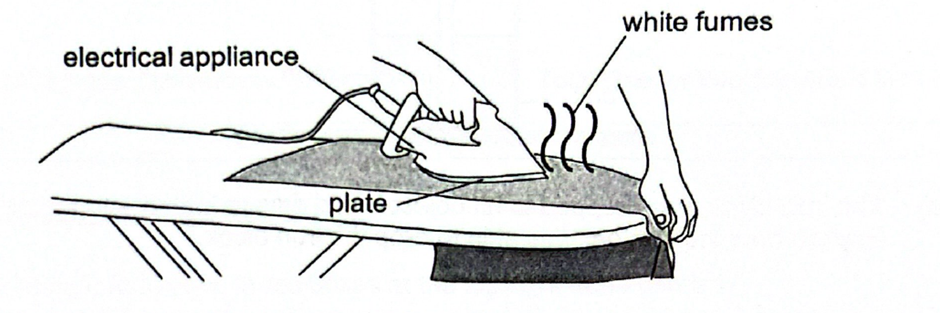 (a) Explain how the white fumes were formed. (P5 water cycles concept) [2m]
Why this question is so important (Glow Science insight )
This single question tests THREE major PSLE concepts:
- Water cycle
- Evaporation
- Condensation
- Heat transfer
- Gaining heat
- Losing heat
- Materials
- Good conductor of heat
This is exactly why Glow Science trains students to recognise mixed-topic questions instead of panicking!
When ironing a damp shirt:
- Heat turns water into invisible vapour
- Vapour cools and becomes visible mist
- Once the shirt dries, no more vapour is formed
Simple science — but PSLE checks whether students can explain it clearly.
| Year | Scenario | Concepts Tested |
|---|---|---|
| 2020 | Frozen sausages | Condensation + freezing |
| 2021 | Fogged spectacles | Condensation |
| 2025 | Ironing damp shirt | Evaporation + condensation |
Same science concepts. Different story and scenario.
Plant Transport System
Imagine this.
You’re watching Paul Hollywood Eats Japan — and suddenly, he buys one strawberry. Not a box. Not a punnet. One strawberry.
Price tag? ¥50,000 — about S$400.
Perfect shape. Glossy red. Juicy. Flawless.
At this point, most of us are wondering: “Why is this strawberry so expensive?”
Here’s the key idea. That strawberry is expensive because farmers intentionally grow it this way — using their understanding of how food moves inside a plant.
And believe it or not, this same idea appears in PSLE Science.
(Curious? You can watch the clip from Paul Hollywood Eats Japan here if you’d like to see the strawberry for yourself.)
Why this matters in PSLE Science
The plant transport system is a commonly tested topic, especially questions involving the food-carrying tubes and water-carrying tubes.
Most students can recall that food is made in the leaves and water is absorbed by the roots, but problems start when the question introduces removing part of the stem.
Questions involving the food-carrying tubes can be tricky because the outcome changes depending on where along the stem the tubes are removed. This is where memorisation alone is no longer enough.
Let’s take a closer look at the following question where a plant’s food-carrying tubes are removed.
| Leo conducted an experiment using two similar plants. He removed an outer ring from the stem of one plant. The food-carrying tubes were removed, while the water-carrying tubes remained.
Suggest why the plant with the outer ring of stem removed produced bigger fruits than the other plant. [2m] |
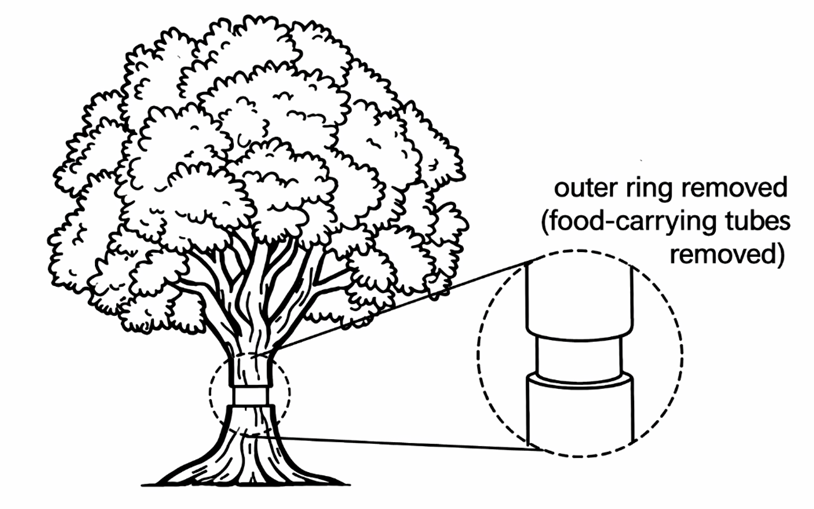 After some time, the two plants produced fruits as shown below.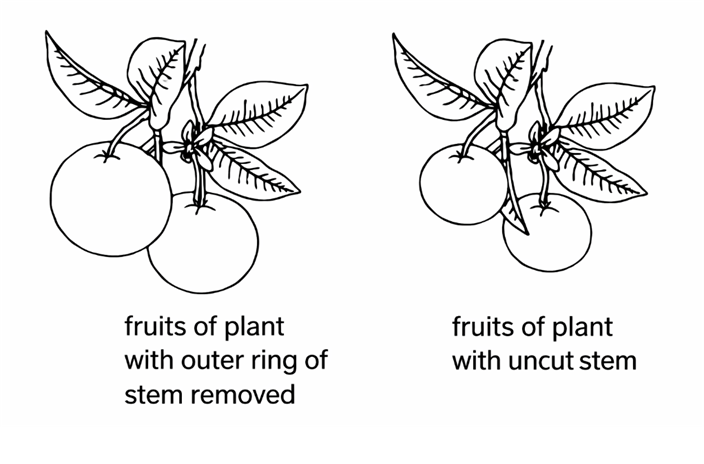
How to think about this question (the Glow Science Way)
Before attempting this question, students must first read and interpret the information provided in the questionclearly. Let us highlight the important information and annotate together.
Leo conducted an experiment using two similar plants. He removed an outer ring from the stem of one plant. The food-carrying tubes were removed, while the water-carrying tubes remained.
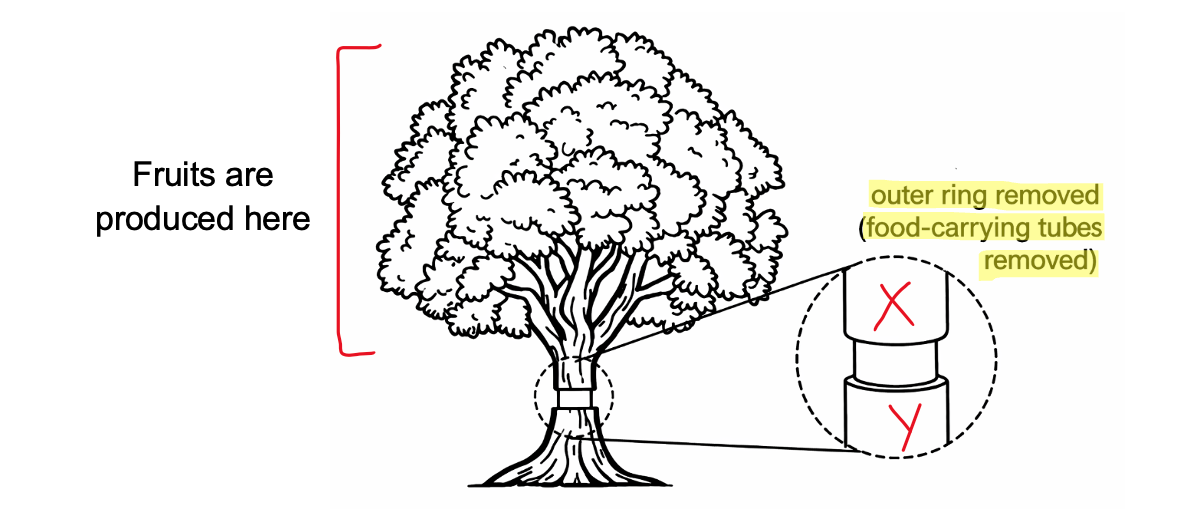
After some time, the two plants produced fruits as shown below.
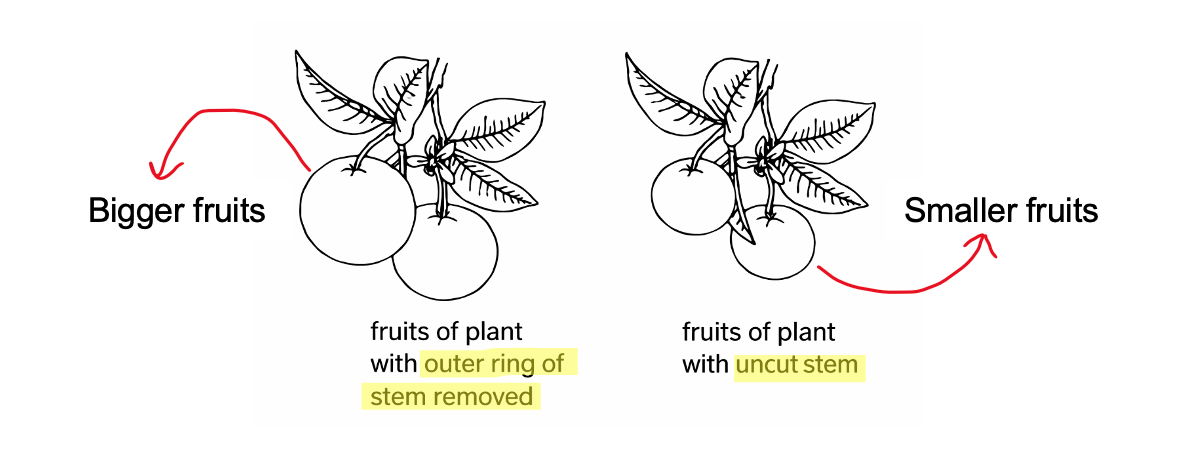
After highlighting the important information and annotating what is observed, students then must be able to identify the core concepts tested.
The question clearly states that there are two plants.
One plant has its outer ring removed, while the other has a normal stem. It also clearly tells us that with the removal of the outer ring, only the food-carrying tubes were removed.
At this point, students should recall “WIFO”:
- Water-carrying tubes are found on the inner side of the stem
- Food-carrying tubes are found on the outer side of the stem
This means both plants can still receive water, but the movement of food will be affected in the plant with its outer ring removed.
Core concepts tested:
- Function of food-carrying tubes
- What happens when food-carrying tubes are removed
How is food transported around the plant?
The food-carrying tubes transport food (in the form of sugar) made in the leaves to other parts of the plant. Food from the leaves may move up or down the plant through the tubes in the stem.
What happens when the food-carrying tubes are removed?
Food made in the leaves cannot be transported downwards beyond the stem where the outer ring was removed, to the roots (labelled Y on diagram).
What happens when food cannot be transported downwards?
Food will be accumulated above the stem where the outer ring was removed (labelled X on diagram). Excess food made by the leaves will be stored and accumulated in the fruits produced by the plants.
This explains why the fruits of plant with outer ring removed are bigger than the fruits of plant with uncut stem.
Now that we have identified the concepts tested, let’s pause and recall the keywords that are required to answer the question with precision!
Keywords:
- Food made by the leaves
- cannot be transported
- excess food
- accumulated and stored in fruits
Using the G.L.O.W signature technique, we can formulate the answer to suggest why the plant with the outer ring of stem removed produced bigger fruits than the other plant.
A mini recap of the G.L.O.W technique:
| Step 1: (G) Provide a direct answer to the question.
This is not needed as there is no direct answer to the question. |
| Step 2: (L) Quote evidence from the question.
The outer ring of the stem was removed. The food-carrying tubes were removed. |
| Step 3: (O) Use concept(s) and keywords to link to evidence.
Food made in the leaves cannot be transported. Excess food will be stored and accumulated in the fruits. |
| Step 4: (W) Make a conclusion to link back to question.
The plant with outer ring removed produced bigger fruits than the other plant with uncut stem. |
Altogether, this is what your answer should look like:
As the outer ring of the stem was removed and it is where the food-carrying tubes are found, the food-carrying tubes are removed. Hence, food made by the leaves cannot be transported to the roots. The excess food is stored and accumulated in the fruits, so the plant with the outer ring removed produced bigger fruits than the other plant.
Conclusion: What students should take away
This question is not testing whether students can memorise that food is made in the leaves.
It is testing whether they understand how food is transported in a plant — and what happens when the food-carrying tubes are removed.
At the end of the day, strong answers are not just about spotting keywords. They are about understanding the processand explaining it step by step using proper answering technique.
That is the kind of thinking PSLE Science rewards. When students are able to do this, even more challenging questions become much more manageable!
Our Programmes at a Glance

 Weekly Classes (P3–P6)
Concept-based, technique-driven, and aligned with the MOE syllabus.
Each week, your child learns key concepts, answers strategies, and applies them through guided hands-on activities. With close support from our experienced teachers, they gain confidence, topic by topic.

 PSLE Science Booster (Highly Popular!)
This is our most in-demand PSLE crash course. We pick out likely exam-tested questions and teach the precise techniques needed to answer them.
✅ Focused open-ended question training
✅ High-yield topics from past year trends
💬 "Teacher, the question really came out!" — a common phrase we hear from our students after PSLE.

 Online Classes – 1-Hour Revision Programme
Busy schedule? We’ve got you. Our popular 1-hour online revision classes are perfect for efficient, high-impact learning — from the comfort of home.
We use top school exam papers and teach students:
✅ How to analyse tricky questions
✅ What techniques to apply
✅ How to spot common mistakes — and avoid them
Just one hour a week — and we do the hard work for you.
Unlock the Key to PSLE Science Success with Glow Science!
Step 1: Chat with us on WhatsApp
Have questions? Not sure which class fits your child best?
Message us directly! We're here to walk you through the options, no pressure.
Step 2: Book a trial class
Let your child experience our G.L.O.W Signature Technique in action.
In this trial session, your child will experience our teaching approach, pick up useful exam strategies, and connect with our Science tutors.
Step 3: Get matched to the right class
After the trial, we’ll assess your child’s needs and recommend the most suitable class level so they can start strong and stay motivated.
